


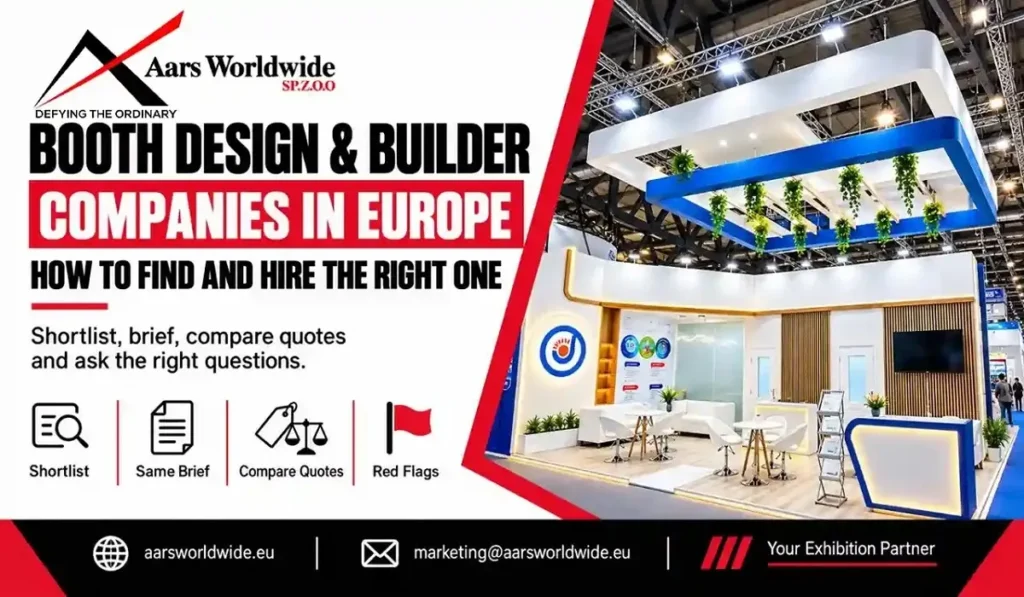
So this guide is about telling them apart before you sign. It covers what to look for, where to look, how to compare quotes and which questions show you who you’re really dealing with. If you want an exhibition stand builder who will work to a clear brief, start here.
The short version
- Decide whether you need design only, build only or design and build.
- Shortlist three or four companies and ask each for photos of finished stands, not just renders.
- Send every one of them the same written brief.
- Compare quotes line by line, not by the total.
- Ask who actually builds your stand, who is on site and who deals with the venue.
Start by deciding what you need
If you want one point of contact, look for a design and build company that handles concept, production and installation under one roof. If you split design and build between two companies, you’re the one coordinating the handover.
The same goes for on-site work. An exhibition stand contractor is who you want making decisions at the venue when something changes at 7am on build-up day.
Pick the format before you pick the company
A custom stand is designed from scratch around your brand and your floor space. It takes more time and design effort, and it suits a show that really matters to you.
A modular stand uses components you can reconfigure and reuse, which makes more sense if you exhibit several times a year.
Where to look for booth design and builder companies in Europe
- The organiser’s exhibitor manual. Some fairs publish lists of contractors, and some venues require builders to be registered. Check what applies to your show.
- Other exhibitors. Ask people who exhibited at your show last year who they used and whether they’d go back.
- Builder pages for your venue city. A company that writes about your city and hall usually knows it.
- Industry contacts and associations. Referrals are still the best filter.
If you exhibit in several countries, a builder with offices in more than one of them can serve you at each show. You can see where we build across Europe.
How to build your shortlist
Ask for references, and read the client testimonials with a critical eye. Look for details about communication and delivery, not just praise for the design.
New to exhibiting? Our first-time exhibitor checklist covers the planning around the stand, and our guide to selecting an exhibition stand builder for a trade fair goes deeper on the shortlist.
Brief everyone the same way
Compare quotes line by line
A much lower price usually means something is missing from the scope. Our breakdown of what an exhibition stand costs in Germany shows which items to look for.
Questions worth asking
- Who will manage my project, and who will I talk to day to day?
- Do you build in-house or use subcontractors?
- Who handles drawings, venue approvals and technical orders?
- What happens if we need to change something late?
- Can you ship and store the stand if we need that?
For a longer list, read our piece on questions to ask a European exhibition stand builder.
Things that are different in Europe
If your show is in Germany, our guide to choosing an exhibition stand builder in Germany covers what to check there.
What to agree in writing
- The full scope, and what’s not included.
- The design sign-off steps and the number of revisions.
- The schedule, including build-up and dismantling dates.
- Who is responsible for approvals and technical submissions.
- The payment schedule.
- What happens if something is late or doesn’t match the approved design.
Red flags
- You only see renders, never finished stands.
- The quote is a single number with no breakdown.
- Nobody can tell you who builds the stand.
- The price is far below the others, with no explanation.
- Replies are slow before you’ve even signed.
- They don’t ask about your goals or your products.
When to start
Earlier than you think. For a custom stand, start talking to builders several months before the show. Our guide on how early to book an exhibition stand builder breaks the timeline down month by month.
How we work at Aars Worldwide
Conclusion
The right builder is the one who answers your questions clearly, shows you finished work and puts everything in writing. Take your time with the shortlist, compare quotes line by line and check who will really be on site. If you’re comparing booth design and builder companies in Europe right now, get in touch with our team and we’ll help you shape your brief.