


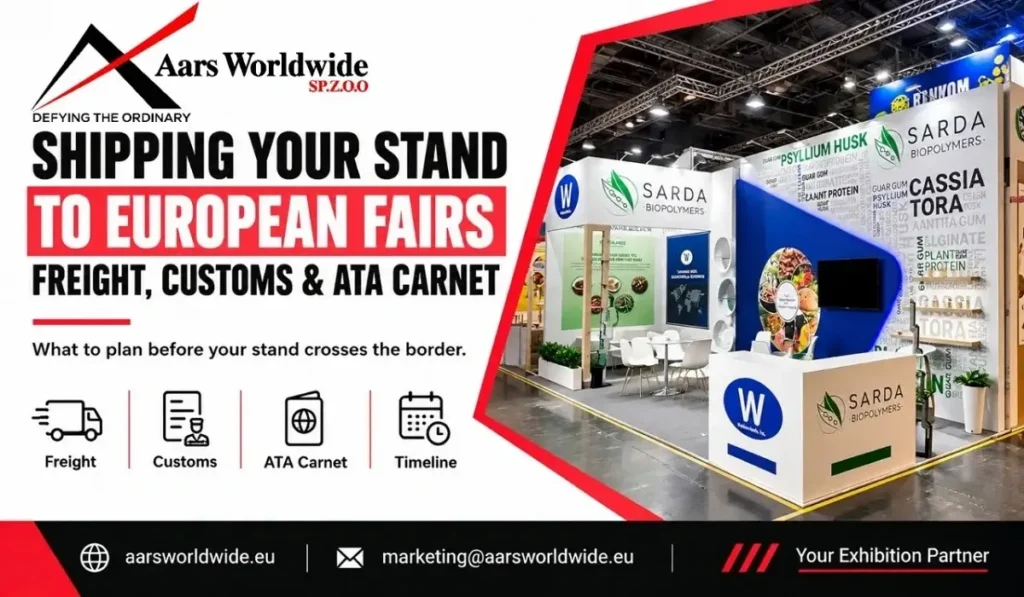
This guide covers the three things exhibitors ask us about most: freight, customs and the ATA carnet. It also explains when it makes more sense to build in Europe instead of shipping. If you are still early in your plan, start with our guide on how early to book an exhibition stand builder.
Should You Ship Your Stand or Build It in Europe?
Ship your own stand
This works well if you already own a reusable system, such as a modular stand, and want the same look at every show.
Build a new stand in Europe
A builder with production in Europe can make the stand close to the venue, so there is much less to ship. Aars Worldwide has in-house manufacturing and offices in Poland, France, the Netherlands, the UK, Italy and Spain, and regional production near key venues can lower freight costs.
Use a rental stand
Our trade show booth setup service includes a rental inventory of modular aluminium booths, custom builds and double-decker stands, so you can bring only your products and graphics.
How to Ship Exhibition Stand to Europe: Freight Options
- Sea freight usually costs less for large, heavy loads, but it takes longer and adds port handling and delivery to the venue.
- Air freight is faster but costs more. It suits urgent items and small volumes.
- Road freight is the usual choice inside Europe, because it can deliver to a set time slot.
For large exhibits and booth construction materials, use a freight forwarder. Messe Frankfurt’s customs guidance for exhibitors says a forwarder can take care of customs formalities on your behalf. Be careful with parcel and courier services. Some organisers warn that couriers often fail to deliver during build-up.
Customs: What Happens at the Border
- Inside the EU, goods move between member states without import customs. You still have to follow the venue's delivery rules.
- From outside the EU, goods brought in for use or display at a fair must be declared to customs when they enter the EU.
- UK, Switzerland and other non-EU countries in Europe have their own customs procedures, so treat them as separate entries.
What Is an ATA Carnet?
What a carnet does not cover
How to use a carnet well
- Apply early. Carnets are issued through your national chamber of commerce network, and processing times vary.
- List every item. Your general list should describe each item. For electrical items, include the make, model and serial number.
- Show the carnet at every border. Customs must see it each time you import, export or pass through a country, and the vouchers are stamped as you go.
- Bring everything back in time. If goods are not re-exported before the carnet expires, or if they are lost or destroyed, duties and taxes can become payable.
Exhibiting From the UK
If you are based in the UK, our page for exhibition stand builders in the UK explains how we work with UK exhibitors. Building closer to the show can also mean less to ship in the first place.
Packing: Crates, Wood Rules and Labels
- Check the wood packaging rules. All wood packaging material and dunnage from non-EU countries must be heat treated or fumigated to the ISPM 15 standard, made of debarked wood, and officially marked with the ISPM 15 stamp. Belgian food safety agency explains the EU rules. Processed wood such as plywood is exempt, but confirm this with your forwarder.
- Use sturdy crates and protect panels and graphics, because finishes scratch in transit.
- Label every crate with the show name, hall, stand number, exhibitor name and contact details.
- Prepare a detailed packing list that matches your customs documents.
- Take photos before sealing, in case you need to make an insurance claim.
- Insure the cargo. A carnet is a customs document, not insurance, and organisers often expect exhibitors to insure their own goods during transport and build-up.
Delivery at the Venue
Make sure someone is on site to receive and sign for your crates. Our installation and dismantling service includes coordinating deliveries, access slots, storage and supplier movements, along with on-site supervision of the build.
What to Budget For
- Crating and packing materials
- Freight, by sea, air or road
- Customs clearance and forwarder fees
- The carnet fee, or the security for temporary admission
- Cargo insurance
- Venue handling and storage charges
- Return freight, or storage until your next show
Plan the Timeline Backwards
- Build-up start: your delivery window at the venue.
- Arrival in Europe: allow time for customs clearance and delivery to the venue.
- Dispatch date: based on your freight mode.
- Carnet or customs documents: apply well before dispatch.
- Packing and crating: finish before the freight pickup.
- Design approval and production: complete these before packing starts.
After the Show: Dismantling and Return
Quick Pre-Shipping Checklist
- Decide whether to ship, build locally or rent
- Choose a freight forwarder and a freight mode
- Apply for the carnet or arrange temporary admission
- Check wood packaging, labels and your packing list
- Insure the cargo
- Confirm the venue's delivery window and who receives the goods
- Plan the return before you send
How Aars Worldwide Supports Exhibitors
Conclusion
Not sure which route suits your show? Contact Aars Worldwide with your show, stand size and dates, and we will tell you what we would do.