
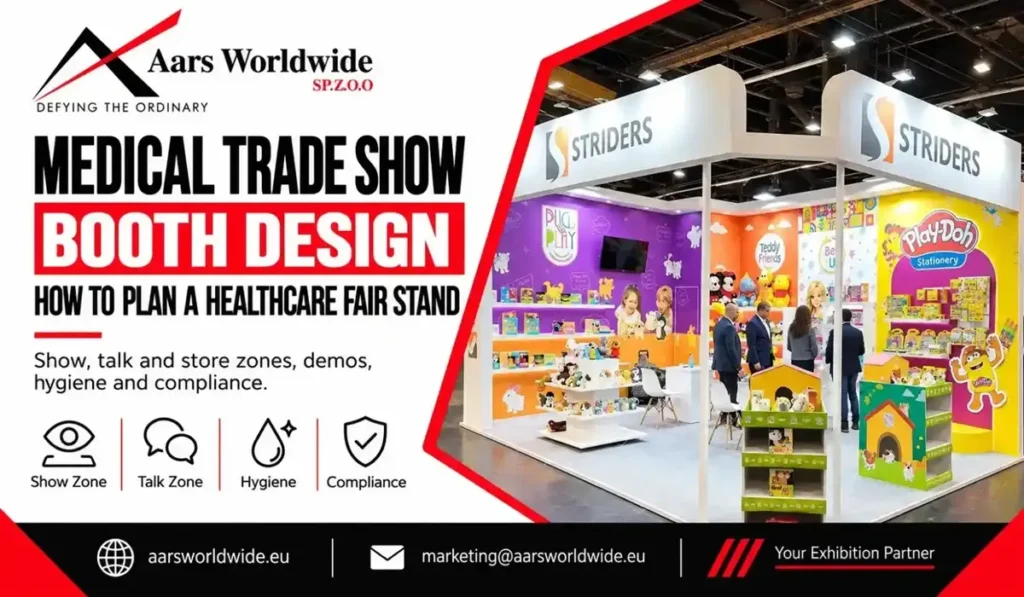
Medical Trade Show Booth Design: How to Plan a Stand for Healthcare Fairs

Picture a surgeon walking a hall with ten minutes to spare. She isn’t browsing. She’s looking for one specific answer, and she’ll decide within seconds whether your stand is where she gets it. A cluttered booth with a sales pitch on every wall loses her. A calm one with a clear message, a working demo and somewhere quiet to talk keeps her.

That’s the whole job of medical trade show booth design: make a technical product easy to understand, easy to try and easy to discuss. Two of the best-known healthcare fairs, MEDICA and REHACARE, run in Düsseldorf in Germany, and both put a lot of exhibitors in front of specialist visitors. Here’s how to plan a stand that holds up.

Who you’re designing for

Healthcare visitors tend to be clinicians, researchers, procurement teams, distributors and specialists. They ask technical questions, they compare products, and they remember the stands that felt trustworthy. Stands for healthcare, pharmaceutical and laboratory brands often need a more formal setting than a consumer show would: somewhere for product information, professional meetings and demonstrations.

So the design questions change. Less “how do we look exciting?” and more “how do we make this clear, credible and easy to talk about?”

Know the fair you’re designing for

MEDICA runs in Düsseldorf every November, and the 2026 edition is on 16–19 November. It brings together more than 5,000 exhibitors across diagnostics, surgery, physiotherapy, health IT and more, so the audience is broad and the hall is busy. If that’s your fair, our MEDICA page has the details. For a stand there, clarity beats cleverness: one message you can read from the aisle and one reason to step inside.

REHACARE International, also in Düsseldorf, focuses on rehabilitation, care, mobility and independent living. The 2026 edition ran 23–26 September with over 700 exhibitors. Visitors include therapists, nursing staff, rehab centres and home care providers, and the fair is aimed at people with disabilities, chronic conditions and older people as well. That changes the brief. Step-free access, wider paths inside the stand, lower counters and proper seating matter as much as the look. Our REHACARE page covers the fair.

Plan three zones: show, talk and store

Most medical stands work best with three zones.
Put the demo near the front and the meeting area at the back. Visitors see activity first, and the conversations that matter happen away from the aisle.

Let the product do the talking

Raise devices on plinths or shelves at a sensible height, light them well, and give each one a short label: what it is and what it does. Keep paperwork to a minimum. A screen or a QR code can carry the detail without covering the walls in text.
Give larger equipment room. Machines and devices need operating clearance, a safe viewing distance and access for your team. Plan power points for every demo at the design stage, along with cable routes. They are hard to fix once the stand is built.
Let people try things. A demo that visitors can touch is remembered far longer than one they watch, and it gives your staff a natural way to start a conversation.

Hygiene and materials

Hygiene needs should be identified during the briefing and checked against the event’s rules, along with electrical equipment and safety requirements. In practice, that means surfaces that are easy to wipe, sealed counter finishes, a hand sanitiser point, and flooring that copes with demos and heavy foot traffic. Skip decoration with hard-to-clean gaps and loose fabric around devices.

Showing devices that aren’t certified yet

This one catches people out. If you exhibit a medical device that doesn’t yet comply with the EU Medical Devices Regulation, you can still show it at a trade fair, but only with a visible sign making clear it’s for presentation or demonstration only and can’t be made available until it complies. That’s set out in Article 21(3) of Regulation (EU) 2017/745. A similar rule applies to in vitro diagnostic devices under the IVDR.
Plan that sign into the design, on the product and on the graphics, so it’s clear and doesn’t look like an afterthought. This is general information and not legal advice, so check the wording with your regulatory team and the organiser.

Meeting spaces that feel private

Clinicians and buyers talk about prices, clinical data and procurement. They won’t do that in the aisle. Give them a closed or semi-closed space with good sound absorption, comfortable seating and a screen for presentations. A small sign that says a meeting is in progress saves your team a lot of awkward interruptions.

Lighting and screens

Hall lighting is often flat, so use your own lighting to make the product the brightest thing on the stand. Choose neutral, clean light that doesn’t change how products look. Keep screens simple, with large text and one message per screen.

Custom stand or something simpler?

A custom stand lets you shape the layout around your product: where the demo goes, how big the meeting room needs to be and how equipment gets in. If you’re launching something new or exhibiting large devices, that freedom is worth having. If your needs are simple, a smaller, well-planned stand can do the job.

What it costs

Medical stands often carry extra line items: meeting rooms, storage, electrical for demos and the handling of larger equipment. Our breakdown of what an exhibition stand costs in Germany shows where these tend to appear. Ask for an itemised quote and check what sits outside it, such as venue services, electricity and rigging.

Choosing the right builder

Technical fairs reward builders who read the organiser’s guidelines and ask about your product before they design. Our guide to choosing an exhibition stand builder in Germany lists what to check. For a healthcare stand, add these three questions:

Five mistakes to avoid

Conclusion

Good medical trade show booth design comes down to clarity, trust and space to talk. Plan your zones, give the product room and sort out compliance early. If you’re preparing for a healthcare fair, get in touch with our team and we’ll help you shape the brief.


Frequently Asked Questions

What should a medical trade show booth include?
A clear message visible from the aisle, a demo area, a quieter meeting space, storage for samples and staff items, and surfaces that are easy to keep clean.
It depends on what happens on the stand. Start from your equipment, demos and meetings, then work out the size, rather than the other way round.
Under the EU Medical Devices Regulation, yes, at a trade fair, as long as a visible sign says it’s for presentation only and can’t be made available until it complies. Check the details with your regulatory team and the organiser.
Yes. Step-free access, wider paths, lower counters and seating help every visitor, and they matter especially at fairs such as REHACARE.
MEDICA is broad and busy, covering diagnostics, surgery, health IT and more, so clarity from the aisle matters most. REHACARE centres on rehabilitation, care and mobility, so accessibility and comfort come first.
As soon as you’ve confirmed your stand. Stands with meeting rooms and equipment need time for design, approvals and production.