

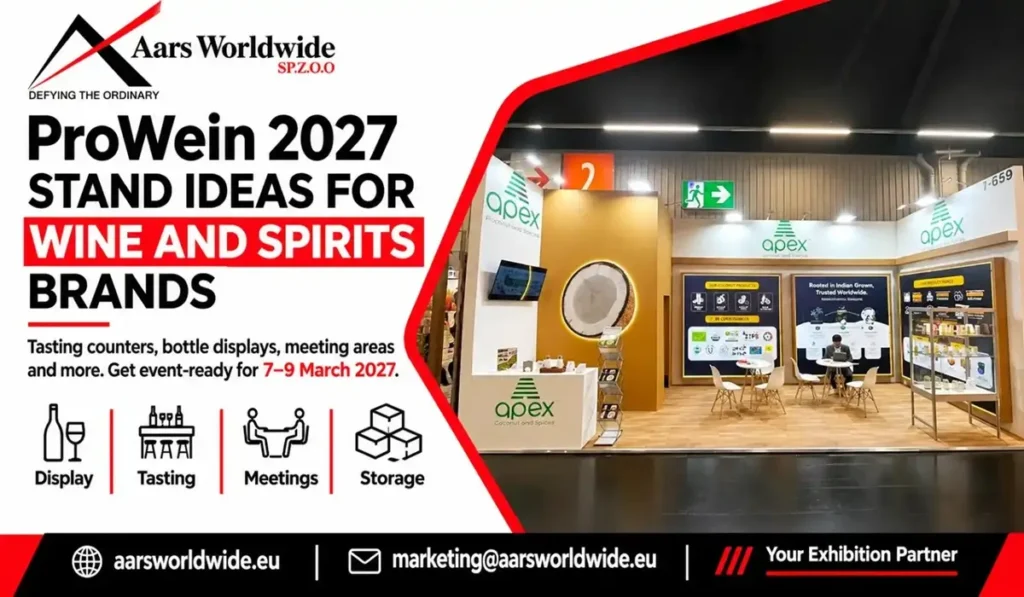
ProWein takes place in Düsseldorf on 7–9 March 2027 and brings the international wine and spirits trade together. Whether you already work with an exhibition stand builder in Düsseldorf or are still comparing options, these are the ideas we would build around.
Start with the brief, not the render
Plan the layout in four zones
- Display. The range, front and centre, visible from the aisle.
- Taste. A counter or table for tastings, if you are pouring.
- Talk. A quieter area where a buyer can sit, try products and discuss terms.
- Store. Hidden storage for stock, refills and staff items, so the front stays clean.
Make the branding readable from the aisle
- One message, big. A short line about who you are or what is new beats a paragraph.
- Use your label and packaging colours. They are already recognisable, and they tie the stand to what buyers will see on shelves.
- Plan the hierarchy. Logo, messaging, graphics and products should work as one picture, without clutter. If you have several brands or ranges, decide which one leads.
- Show real pack shots, large. A big, clear image of the bottle does more than a lifestyle photo nobody connects to the range.
Display bottles so buyers can judge them
- Put the hero first. Your new launch or best seller goes at eye level, near the front.
- Fewer bottles per bay. Crowded shelves hide the range. Group by style, colour or category.
- Build a mock retail shelf. It lets buyers see shelf appeal and bottle facings, not just a bottle in a box.
- Use closed cabinets for premium lines. They protect the product and signal quality.
- Make refilling easy. Shelves that restock from behind keep the front looking full without interrupting a conversation.
Light the bottles, not the glare
Good lighting makes colour look appetising. Aim it at the product, and avoid mixing very cold and very warm lights, which makes products look different in different parts of the stand. Keep hot spotlights away from bottles and samples.
Glass and polished surfaces reflect, so it pays to check colour, reflections and visibility under show lighting before opening day. exhibition stand lighting design and LED screens explains light layers and glare in more detail.
Plan the tasting like a flow, not a counter
Place the counter near the front, but not in the entrance, and leave standing room around it. If you expect to be busy, build two tasting points instead of one. Check your fair’s exhibitor manual for anything that affects tastings. To an interactive stand for product sampling explains the full flow, from the first taste to the follow-up.
Give buyers somewhere to sit
If floor space is tight but your needs are not, a double-decker exhibition stand adds an upper level for meetings and hospitality. It needs structural checks and venue approval, so ask early whether it is possible in your hall.
Custom or modular?
If ProWein is your main show of the year, a custom exhibition stand lets you shape the layout, the shelving and the tasting counter around your range, with finishes that match your labels. If you take the same stand to several shows, a modular stand can be reconfigured for each footprint.
Build in Düsseldorf and plan early
A builder who knows the city also knows the venue. Our Düsseldorf stand building service covers design and fabrication, 3D visualisation, logistics, installation, on-site support and dismantling, and coordinates with the venue and exhibition technical requirements.
ProWein opens on 7 March 2027. Following the booking timeline, the ideal window for a fully custom stand ran from early September to early November 2026, so we are just past it. A straightforward custom build is still possible if you start now, and a modular build can be started between about 14 December 2026 and 11 January 2027. On how early to book an exhibition stand builder explains the timeline in full. If you have not started, speak to a builder this week to find out what is realistic.
Mistakes to avoid
- Showing the whole catalogue instead of a clear hero.
- Branding that is only readable up close.
- A counter at the entrance that blocks the way in.
- Hot lights on bottles and samples.
- No private space for buyers to sit.
- Stock stored in plain sight.
A quick brief checklist
- Your main goal and your target buyers.
- The one wine, spirit or launch you want to lead with.
- Your stand size, position and open sides.
- Your brand colours, logo files and pack shots.
- How many people will be on the stand.
- Whether you will offer tastings, and what your fair's rules allow.
- Your budget range and key dates.