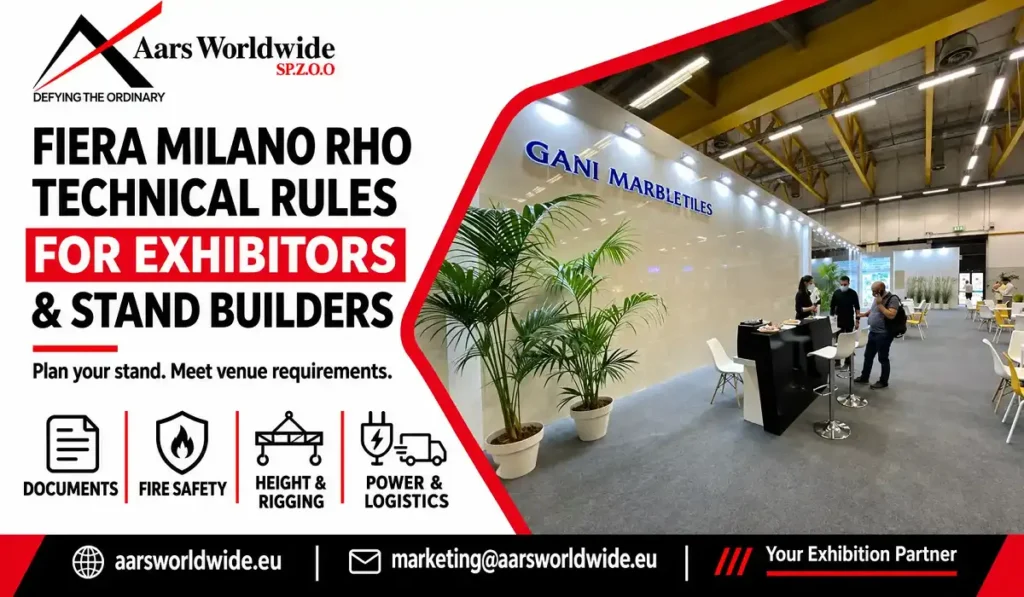
Preparing a stand at Fiera Milano Rho takes more than an attractive design. The venue has technical regulations covering construction, fire safety, electrics, suspended structures and on-site logistics, and a missed requirement can hold up approval. An experienced exhibition stand builder in Milan will know the paperwork, but it helps to understand what is asked of you before the design is signed off.
Rho hosts many of the biggest international exhibitions in Milan, from furniture and fashion to engineering and technology. Fiera Milano’s Technical Regulations (Revision 02-2026) apply alongside each show’s own general regulations, and the organiser may add design instructions, deadlines and hall-specific rules. Your stand has to meet both.
Rho layout and access
Rho is a large complex of numbered halls, gates, loading areas and internal roads, so where your stand sits decides how materials and equipment reach it. Before you finalise the design, confirm your hall and stand number, the boundaries of your space, the position of columns, floor wells and technical services, utility connection points, the nearest unloading access and the build-up and dismantling dates. The exhibitor is responsible for checking the dimensions and service positions before installation, and any mismatch should go to Exhibitor Assistance. Everything must also stay inside the allocated area, so check that counters, doors and storage do not creep into the aisle.
The Stand Construction File
Documentation is where many projects get stuck. Fiera Milano asks for a set of technical declarations and certificates known as the Stand Construction File, and what goes in it depends on the stand. A simple stand and a structure with a mezzanine or hanging elements will not need the same submissions.
The 2026 regulations say the electrical declaration must refer to Italian Ministerial Decree 37/08 and include the contractor’s Chamber of Commerce registration certificate. The declaration of correct assembly and any testing certificates must reach the venue 24 hours before the show opens, and missing that deadline can leave the stand classed as unusable and closed to visitors.
Documents sent to Fiera Milano must be in Italian or English. Even so, not every organiser form comes in English, so check each form’s language early, use the latest version from the Exhibitor Portal and keep an Italian-speaking contact for questions. Do not swap an official template for your own translation.
Fire certificates
Combustible materials, including partitions, platforms, coverings, fabrics, curtains and false ceilings, must meet the applicable Italian fire-reaction classes or their European equivalents. The class required differs for floors, walls and ceilings, so check each certificate against how the material is actually used. Printed fabrics, decorative panels and custom ceilings are where fire-rated stand materials cause the most trouble, so keep the certificates and the fire-safety materials declaration ready before installation.
Height and structures
There is no single maximum height at Rho. The 2026 regulations say exhibitors must follow the maximum fitting heights in the general regulations for their event, so confirm yours with the organiser before the design is final.
Structure type matters too. The venue separates simple and complex structures, and certain thresholds trigger Italian construction-site safety rules, such as structures at least 6.50 m high and mezzanines with an upper-floor projection over 100 sqm. A raised platform open to the public and higher than 0.30 m needs a project, static calculations and testing certification on top of the usual documents. These are compliance thresholds, not permission to build that tall. A multi-level exhibition stand also needs stairs, guardrails and evacuation routes that meet the rules, so a visual alone will not get you through.
Rigging
Ceiling suspension is controlled by the venue. Rigging requests go through the Fiera Milano Exhibitor Portal, and the venue lays cables on the fixed pavilion structures and positions its own suspension cables. Its published rules give a maximum load of 1.5 kN per suspension point every 4 m of purlin, and the number and position of points are set from your technical project. A submission may need a plan of every suspension point, the size and weight of the structure and attached equipment, details of trusses, cables and motors and static calculations from a qualified professional. Do not design a hanging sign around an assumed load.
Power and compressed air
Plan electricity around what will actually run on the stand: lighting, LED walls, demos, machinery, fridges and catering kit. The regulations list 32 A and 125 A connections, and a 32 A connection supplies up to 18 kW at 400 V three-phase. Needs above 70 kW must be requested at least 60 days before set-up or early entry. The exhibitor is responsible for the stand’s installation, which must comply with DM 37/08, while the venue connects its own supply points.
Foreign electricians usually cannot issue the Italian declaration. Use a company authorised in Italy, or ask Fiera Milano for an electrical system inspection through the Exhibitor Portal.
Compressed air is available in most pavilion areas, generally at about 8 bar with a 12 bar limit. Confirm your utility orders with your equipment list and technical diagram at least 20 days before the event, as availability after that is not guaranteed and rates may change.
Logistics and build-up
Build-up and dismantling dates come in event-specific instructions, so never reuse another show’s timetable. Before dispatching anything, line up transport bookings and delivery slots, vehicle and contractor passes, unloading arrangements, delivery sequence, packaging storage, technical checks, final cleaning and dismantling. Contractors must also meet the venue’s technical-professional requirements, and depending on the work, safety documents such as DUVRI, PSC and POS may be needed.
Checklist before build-up
Submission deadlines depend on the exhibition, so check the organiser’s manual and the portal instead of applying another show’s date. Leaving enough time for the Stand Construction File is one more reason for booking your stand builder early.
Always check it against the latest venue regulations and your organiser’s instructions.
Conclusion
Rho rewards early planning. Settle height, fire classes, rigging and electrics first, then build the documents around them. If you want help with stand design in Italy, from the first drawing to handover, talk to Aars Worldwide.
Frequently Asked Questions