


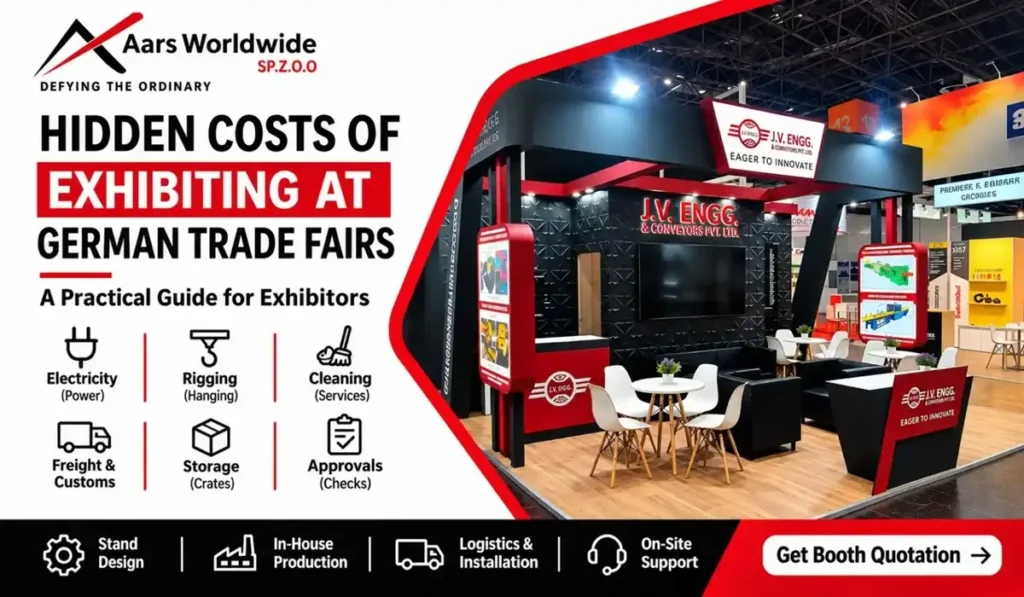
As an exhibition stand builder in Germany, we see the same surprises every season. This guide lists the costs that tend to sit outside the stand quote, explains how each one works and shows you how to find them before you commit to a budget.
Why these costs feel hidden
For a full breakdown of the stand itself, read our guide on how much an exhibition stand costs in Germany. This article covers what comes after it.
The costs that catch exhibitors out
Electricity
Rigging
Cleaning, security and internet
Freight and customs
Storage
Approvals and technical checks
Other organiser charges
At a glance
| Cost | What It Covers | The Easy-to-Miss Detail |
|---|---|---|
| Electricity | Power for the stand | Usually billed per kilowatt by the organiser |
| Rigging | Hanging signs and overhead structures | Charged by the venue or a third party |
| Venue Services | Cleaning, security, internet | Cleaning contracts can be compulsory |
| Freight | Shipping and customs handling | Often missing from the stand quote |
| Storage | Empty crates during the show | Billed separately |
| Approvals | Structural and fire checks | Needed for larger, taller and two-storey stands |
| Organiser Charges | Registration, insurance | Check the organiser's documents |
How much can they add?
There is no fixed figure, because every fair and every stand is different. As a rule of thumb from our cost guide, these extras can add fifteen to forty percent on top of the stand build cost. For every 100 you spend on the build, it is safer to plan for another 15 to 40 on top.
How to spot them in a quote
- Confirm each quote covers the same stand size, hall and show dates.
- Check whether design revisions are capped, or billed per round past a limit.
- Ask who books electricity, rigging and venue services. Some builders handle this for you, and others leave it entirely in your hands.
- Ask what is included for installation, dismantling and logistics.
- Ask what happens to the stand after the show. A stand stored for reuse can lower your cost at the next event, while a one-off build usually has disposal built into the price.
Ways to keep the total under control
- Split essentials from nice-to-haves. List what the stand must have, such as the booth, documents and main promotion, and what would only be nice.
- Spend on what shows. Put your budget into the key branding elements, such as product displays, messages and logos.
- Reuse. Modular systems cost less upfront and reuse well across shows, and some elements, such as signage and graphics, can be repurposed.
- Plan early. Requesting a quote four to six months ahead gives builders more time and often leads to better pricing.
What we handle on site
Our on-site support includes venue approvals, such as safety inspections, rigging permits, fire regulations and structure compliance. We also make sure electrical, internet and other utilities are turned on and verified, and we coordinate deliveries, access slots and storage. Tell us your show and stand size, and we will tell you what we handle and what you will need to book yourself.
Conclusion
Frequently Asked Questions
What are the hidden costs of exhibiting at German trade fairs?
How much can these extra costs add?
Are electricity and internet included in the stand quote?
Who books rigging?
What is the biggest hidden cost exhibitors miss?
Four to six months ahead gives builders more time to plan and often results in better pricing than a last-minute request.