


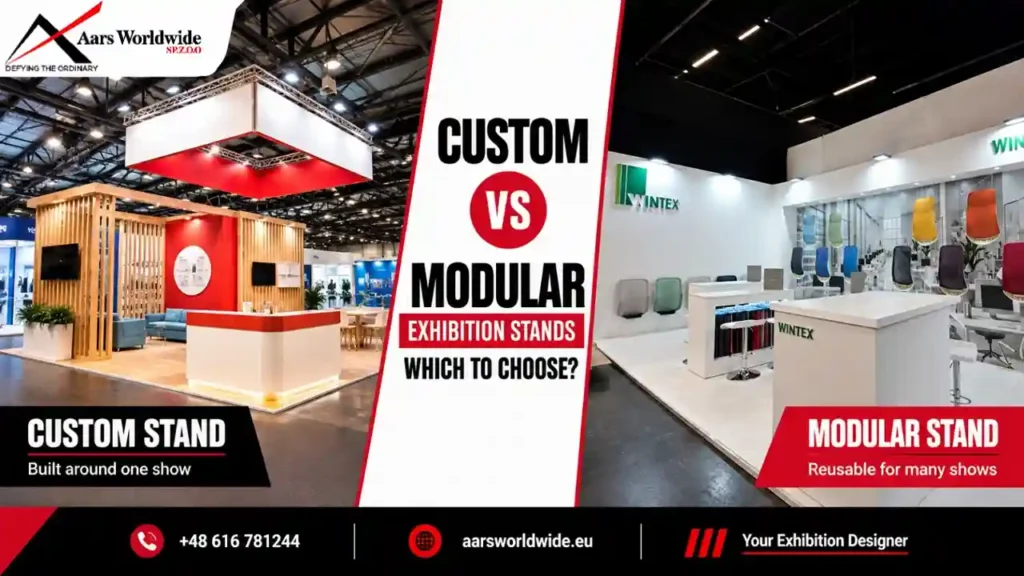
Choosing between a custom vs modular exhibition stand comes down to three things: how often you exhibit, how much design freedom you need and what space you book. A custom exhibition stand is built around one show or one idea. A modular exhibition stand is built from reusable parts that you rearrange for each event.
If you exhibit more than once a year, you’ve probably run into this already. The stand that worked perfectly at one show? Suddenly too big, or too small, for the next. Different hall, different footprint, different neighbours on either side, and just like that you’re paying for a fresh build all over again.
Modular stands exist to fix exactly that problem. Build the system once. Reconfigure it for each event after that, instead of starting from zero every time.
That said, modular isn’t the right call for everyone. Here’s how both options work, where they help, where they fall short and how to decide.
Modular vs. Custom Exhibition Stands
So before comparing prices, compare the scope.
| Factor | Modular Exhibition Stands | Custom Exhibition Stands |
|---|---|---|
| Design approach | Built from components that can be rearranged | Designed around one specific project |
| Reusability | Planned for repeated use | Depends on the original design and construction |
| Flexibility | Layout changes depend on system compatibility | Tailored to a particular space and goal |
| Brand presentation | Graphics and selected elements can be updated | More freedom for distinctive structures and features |
| Best suited for | Repeated shows with changing space requirements | Projects needing a specific design or visitor experience |
Go custom when the brief calls for something special: unique architecture, a complex structure or a tightly branded environment. Go modular when reuse and layout flexibility matter more.
You don’t always have to pick one. Plenty of projects combine a reusable modular base with a few custom-built features made for a particular show.
The goal isn’t picking the cheapest option. It’s understanding exactly what you’re paying for, and whether that scope matches what your exhibition needs.
What Is a Modular Exhibition Stand?
A modular stand is built from separate, reusable parts: frames, panels, connectors, counters, shelving, lighting and graphic walls. You put them together one way today and a different way at the next show.
Say you take a compact 3×3 m stand at a regional event. Six months later you book a 6×3 m corner space at a bigger fair. With a modular system, you extend what you already own instead of commissioning a new stand.
Modular doesn’t mean generic, either. When the graphics, lighting and layout are planned around your brand, a modular stand can look just as sharp as one built from scratch.
What Is a Custom Exhibition Stand?
A custom stand is designed from scratch for one brief. The structure, finishes, lighting and layout all follow your brand and your goals for that specific show.
That gives you the most freedom. You can build unusual shapes, add feature walls or create a distinctive visitor journey. The trade-off is that the design is tied to one space, so reuse depends on how it was built and how well it suits your next venue.
Modular doesn’t mean generic, either. When the graphics, lighting and layout are planned around your brand, a modular stand can look just as sharp as one built from scratch.
How Modular Exhibition Stands Work
It starts with a design based on your space, your goals and how you plan to use the stand over time. The stand is then split into components that fit together. Those get packed, shipped and rebuilt at each venue.
Systems differ a lot. Some use lightweight frames with tool-free connections. Others need tools or a trained installation crew. Before you commit to one, get answers to three questions:
- How do the components connect?
- How are the graphics swapped out?
- Can the system handle a different layout later?
Plan two or three shows ahead, not just the next one in front of you. A system designed around one stand will let you down the moment the next floor plan looks different.
Key Benefits of Modular Exhibition Stands
1. Reusable Components Across Multiple Events
The biggest advantage is simple: you don’t buy a new structure for every show. Frames and panels carry over, and graphics and lighting can too, as long as they still suit your brand and the new layout.
That cuts down repeat spending and material waste. Whether it actually saves you money depends on the upfront cost, storage, freight and how many events you use it at.
2. Flexible Layouts for Different Exhibition Spaces
No two exhibition spaces are alike. One show hands you an open-front stand. The next puts you in a corner. A modular system lets you rework the same parts to fit whatever you’re given.
One caution: not every system suits every shape. Some can’t handle certain geometries, so check what your design really needs before you sign off.
3. Easier Transport and Storage
Modular components are built to be packed up and moved, again and again. Next to a large bespoke structure, they’re usually a lot easier to handle and store.
Still, look past the convenience for a second. Check crate sizes, weight, how many pieces you’re dealing with and where they’ll sit between shows. A stand that goes up in an hour but costs a fortune to ship isn’t much of a win.
4. Faster Installation and Dismantling
Because the structure follows a planned assembly system, there’s less on-site construction than with many bespoke builds. Dismantling and prepping for the next event is simpler too.
Get the installation schedule confirmed in writing. Timing still depends on stand size, venue rules, electrical needs and the experience of the crew. A professional trade show booth setup team can handle the build and keep it on schedule.
5. Suitable for a Regular Exhibition Programme
Several shows a year? A reusable system makes sense. Once the structure is in place, your team mostly updates the layout and swaps a few graphics or display elements each time. Your brand stays consistent across the calendar, while product messaging shifts as needed.
Only exhibiting once or twice? The upfront investment and storage space probably won’t be worth it.
Limitations of Modular Exhibition Stands
Modular systems are flexible, but they aren’t perfect. Know these before you approve a design:
- Design restrictions: Fixed dimensions and connection points can rule out unusual shapes, complex overhead structures or highly customised architectural features. A two-storey build, such as a double-decker exhibition stand, usually falls on the custom side.
- Initial investment: A good system can cost a lot at the start. Weigh that against how often you’ll reuse it, plus storage, transport and maintenance.
- Storage and maintenance: Components need a secure place between shows. Damaged frames, outdated graphics or missing connectors will need repair or replacement.
- Venue and technical requirements: Height limits, hanging elements, electrical requirements and safety regulations can all change the final design.
- Brand differentiation: If you reuse the same structure show after show without refreshing graphics or layout, the stand starts to look stale. Choose a system that lets your presentation evolve.
None of this rules modular out. It just means the decision should rest on your full exhibition plan, not only on the first design.
When Is a Modular Stand the Right Choice?
It’s worth serious consideration if:
- You exhibit at several shows every year.
- You’ll be in different venues or different space sizes.
- Your brand can be refreshed through graphics and layout changes.
- You have the storage and logistics to support repeated use.
- You don’t need a completely unique structure for every event.
When Is a Custom Stand the Right Choice?
A custom stand is usually the better fit if:
- It’s a one-off flagship show where the stand itself is part of the message.
- You’ve booked an unusual or oversized space.
- Your concept depends on distinctive architecture, such as a second level or a feature structure.
- You want a fully branded environment, not a rearranged system.
How to Choose Between a Custom and Modular Stand
Picking a stand isn’t just about fitting your next booth. It has to work for the shows coming after it, too.
1. Review Your Exhibition Calendar
List the shows you expect to attend and compare their space sizes, layouts and locations. Work out which components can carry over and where you’ll need extras.
2. Define Your Exhibition Objectives
Product demos, private meetings, lead capture and brand awareness all need different layouts, display areas, lighting and visitor flow. Decide what the stand has to do before you look at designs.
3. Check System Compatibility
If you’re considering modular, check that the system can handle the sizes and shapes of your planned spaces. Confirm limits on height, connections, graphics and technical installations.
4. Calculate the Total Cost of Use
Add up the upfront price, transport, storage, installation, maintenance and future changes. Then compare that with what the other option would cost over the same programme. A lower upfront price doesn’t always mean a lower total cost, and reusable doesn’t always mean cheap.
5. Plan for Future Changes
Your products, branding and goals will shift. Pick an option where graphics, displays and layouts can be updated without replacing everything.
Final Thoughts
The custom vs modular exhibition stand decision isn’t about which one is better. It’s about which one fits your calendar, your space and your brand.
If you exhibit regularly, a modular stand could be exactly what you need. For a special event that calls for something different, a uniquely designed stand will help you reach your goal. And many exhibitors end up with a mix of both.
Planning your next exhibition? Explore our Modular Exhibition Stands service to find the right setup for your upcoming shows. Want something designed around your brand and exhibition goals? Take a look at our Custom Exhibition Stands service, or contact us and we’ll help you compare both.
Frequently Asked Questions
What is the difference between a custom and modular exhibition stand?
A custom stand is designed from scratch around one project, while a modular stand is built from reusable components that you rearrange for different shows. Custom gives more design freedom, and modular gives more reuse.
Is a modular exhibition stand cheaper than a custom stand?
Not always. A modular stand can cost less over several shows because you reuse the parts, but the upfront price, storage, transport and maintenance still count. For a single show, custom can be the simpler choice.
Can modular exhibition stands be customised?
Yes, within the limits of the system. You can plan graphics, lighting, counters and layout around your brand. Unusual shapes or complex overhead structures are usually easier to build as a custom stand.
Which is better for a first-time exhibitor: custom or modular?
It depends on your plan. If you expect to exhibit at several shows, a modular stand lets you reuse your investment. If your first show is a one-off with a specific concept, custom may suit you better.
When should I choose a custom exhibition stand?
Choose custom for a flagship show, an unusual or large space, or a concept that relies on distinctive architecture, such as a double-decker build.
Can I combine modular and custom elements?
Yes. Many exhibitors use a reusable modular base and add a few custom-built features for a particular show. It’s a practical middle ground.