Walk into any hall at BIOFACH and you’ll see the problem right away: too many booths, not enough time. Buyers are moving fast, scanning, deciding in seconds whether to stop or keep walking. If your stand doesn’t grab them in that first glance, they’re gone – off to the next aisle, next brand, next conversation.
That’s the real challenge for organic food manufacturers, importers and distributors at BIOFACH Nuremberg. It’s not just about showing up. It’s about giving people a reason to slow down.
This is because an effective exhibition stand performs two tasks simultaneously by informing the visitors about the products on offer and facilitating the work of the sales team. When this is done right, everything else becomes simple. Below are ten things you need to consider when planning yours.
1. Use Natural Materials That Match Your Products
Every organic brand has a story – where the ingredients come from, how things are made, what the company actually stands for. Your stand can either tell that story or get in the way of it.
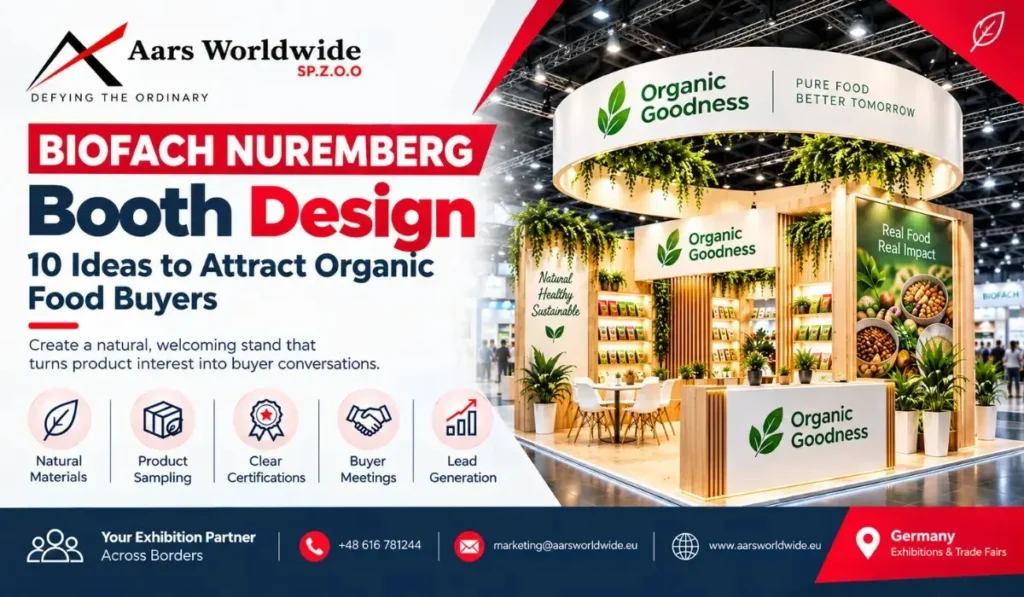
Wood finishes, natural textures, earthy tones. Green, beige, white. These work because they feel like an extension of the product itself, not a marketing layer sitting on top of it.
Picture an organic snack brand, for instance, going with simple wooden shelving and green signage that echoes their packaging – nothing loud, just consistent. That kind of restraint is often what makes a booth feel trustworthy rather than staged.
The trap to avoid: piling on decoration until the products themselves get lost in it. Materials should support the brand, not compete with it.
2. Keep the Booth Open and Easy to Enter
People at trade fairs are busy. If a stand looks like it takes effort to walk into – big counters blocking the front, furniture in the way – most visitors just won’t bother.
Keep the entrance clear. Put your best displays where people can see them from the aisle, not tucked in a corner. Smaller booths benefit from vertical shelving, which frees up floor space without cutting into how much you can show. Larger booths have room to split things up – a demo area here, a meeting corner there.
Really, it comes down to one question: how will people actually move through this space? Answer that first, and the layout mostly figures itself out.
3. Make Product Sampling Part of the Experience
Buyers want to taste before they talk numbers. That’s just how food sourcing works – no amount of packaging description replaces putting something in someone’s mouth.
A snack manufacturer may place smaller samples of different varieties of the product. A beverages company has a taste station for its products. A spices importer enables visitors to smell and sample the real ingredients. No matter what the type is, ensure that it is neat – no one likes waiting in queues at trade shows, and an untidy sampling station will bring down the standards of the product.
The employees need to be prepared for additional queries such as ingredients, packing and availability. It is always advisable to go through the sampling guidelines of the event beforehand since regulations for such events can be very stringent.
4. Display Organic Certifications Clearly
Serious buyers will want to know your certifications, your ingredient sourcing, your compliance standing – and they’ll want to find that information without hunting for it.
Give it a visible spot. Clear signage, only the logos and certifications you’re actually authorised to display. A brief line on sourcing or manufacturing helps too.
A company targeting European distributors, say, might lay out its product categories right alongside the relevant certifications – no separate brochure required, no extra step for the buyer.
Keep the core information simple enough to read while walking past. That’s the real test.
5. Organise Products into Clear Categories
More products on the shelf do not imply more sales; they only mean more confusion. Products should be categorized rationally to ensure that there is nothing outstanding.
For instance, spices can be arranged based on taste and nature while cereals can be arranged depending on whether they are raw or fit for consumption. New products should have their sections to distinguish them from old ones.
Basically, a customer should identify the types of products that you sell by just having a look at your shelves.
BIOFACH isn’t a consumer expo. It’s a business event, and some of your most valuable conversations will need more than a passing chat.
Even the simple addition of a small table with two chairs could be very useful for a tight booth. For bigger stands, there is always a possibility to create a designated area for discussions. In either case, it is important to have all the catalogues and samples handy, so as not to interrupt the discussion to pick anything up.
The preparation should include calculating the number of discussions that will take place before the event.
7. Use Lighting to Highlight Important Products
Lighting changes everything about how a product reads to a buyer. Too dim, and packaging becomes hard to make out. Too bright, and you get glare bouncing off surfaces – especially glass.
It is much better to light up shelving areas, counters, and display areas rather than lighting the entire booth evenly. Using neutral colors helps package colors look right; this is even more significant than most people think.
If your goods are kept in glass bottles or jars, you may want to inspect the lighting angles beforehand as it could happen that the shine coming off the label will make it impossible to see what’s written there.
8. Tell Your Brand Story Through Graphics
Buyers often want more than the product – they want to know where it comes from and why your company does things differently.
And that is how you use graphics – by featuring images such as maps, product photographs, and a short line about your story. For instance, an organic tea business can showcase the places where the tea is grown along with its complete range.
Ensure that your message is brief enough so that people can catch it even while passing by – a headline with good graphics is far better than paragraphs.
9. Use Digital Displays When They Add Value
Screens could be very helpful – when demonstrating a variety of products, illustrating production processes, or playing brand videos. Using QR codes is a simple solution that will help direct clients to your website or catalogue without producing additional material.
The importance of this is more relevant to those companies whose product variety makes it difficult to present their goods through physical display.
However, the use of technology for technological sake does not benefit anybody. In case your products can be sufficiently presented through physical display, screens might be an unnecessary feature.
You don’t always have to pick one. Plenty of projects combine a reusable modular base with a few custom-built features made for a particular show.
10. Design the Stand Around Your Business Goals
Before locking in any design, it’s worth asking plainly: what is this stand actually for?
Launching a product requires a different kind of space than that required when looking for distributors. The product launch might require its own demo space, whereas an organization on the lookout for wholesale distributors would need more space for meetings.
Also keep in mind the amount of floor space you have, your budget, your products, and your staff. Once all of these factors are known, it will become clear what is and what is not included.
Choosing a BIOFACH Nuremberg Exhibition Stand Builder
Designing a stand is only part of the job. There’s also construction, graphics, lighting,
installation and dismantling to think through – and that’s where a lot of exhibitors underestimate the workload.
Aars Worldwide handles custom exhibition stand design and construction, along with modular stands, installation and dismantling, for businesses exhibiting at international trade fairs.
When you bring a builder into the conversation, share your brand guidelines, product categories, floor space and what you’re actually trying to achieve at the show. Mention if you need sampling counters, storage, meeting space or digital displays – the more context the design team has, the closer the first draft lands to what you actually need.
Explore Aars Worldwide’s BIOFACH Nuremberg exhibition stand services to talk through your requirements for the event.
Conclusion
All of these combine to form the total picture. However, all these decisions need to be based on one single factor – how this trade stand needs to be utilized.
Aars Worldwide can help you design a trade stand that will represent your company at BIOFACH Nuremberg.
Frequently Asked Questions