
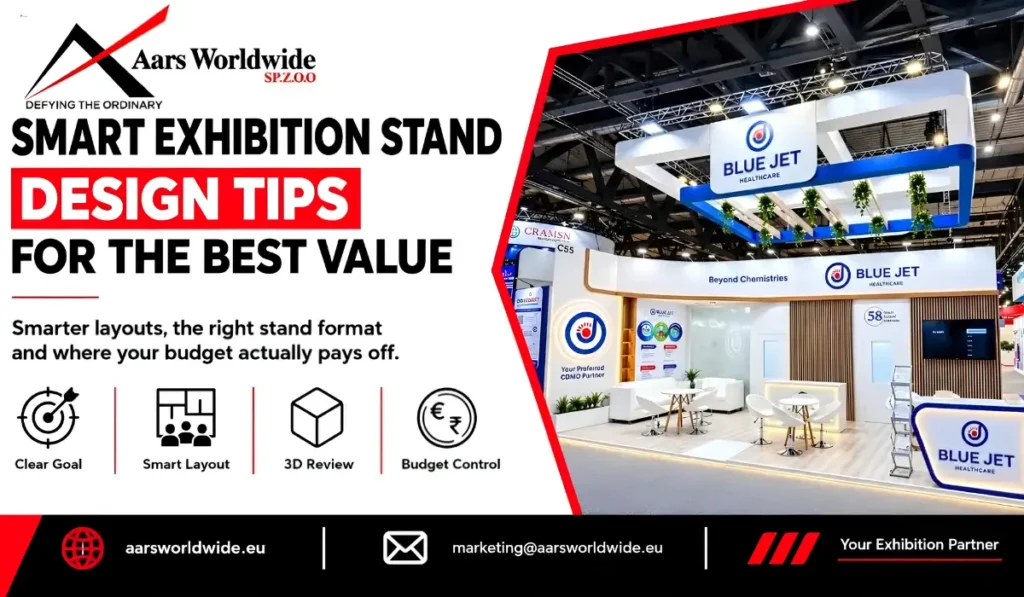
Smart Exhibition Stand Design Tips to Get the Best Value for Your Investment

An exhibition stand is usually one of the biggest items in a trade show budget, and one of the easiest to overspend on. Not because anyone is careless. Money just drifts towards things that look brilliant in a render but do very little once the hall fills up. The exhibition stand design tips below work the other way round: spend where visitors notice it, and where your team will actually use it.

1. Decide What the Stand Is For

Before anyone opens a design file, settle what the stand needs to achieve. Collecting leads? Launching a product? Sitting down with existing customers? Each of these calls for a different layout. A lead-focused stand wants open sightlines and an easy way in. A meeting-focused one needs a closed-off corner where people can actually hear each other. Skip this question and you end up paying for features that have little to do with why you booked the space.

2. Put the Money Where Eyes Land First

Visitors make up their minds within a few seconds, and what they take in during those seconds is the fascia, the main graphic and the lighting. A clear headline, tidy branding and decent lighting will do more for you than a costly feature at the back of the stand that half your visitors never reach.

3. Design for the Way People Walk

Picture the visitor’s path. Where do they come in, where do they slow down, where do they get stuck? Keep the entrance open, angle your main message towards the aisle, and place demos so that a small crowd doesn’t block everyone else. Fixing this on paper is free. Fixing it after the stand is built is not.

4. Match the Format to Your Show Calendar

If one show is the big moment of your year, a custom stand lets you build everything around your products and your story. It costs more, but nobody else will have a stand quite like yours.

Exhibit at several shows a year and the sums change. A modular stand can be rearranged for different floor sizes, so the cost is shared across every show instead of landing on one.

5. Go Through the 3D Render Properly

This is the cheapest time to change your mind. Shifting a counter in a 3D view costs nothing. Shifting it after fabrication costs real money. Ask to see the stand from several angles, with lighting, furniture and meeting areas included, before you sign off on production.

6. Use Tech Only Where It Pulls Its Weight

A screen running a product demo earns its place. A screen that simply fills a blank wall rarely does. Decide what you want visitors to see or hear, then plan audio-visual services around that. Cable routes, power points and viewing angles are far easier to sort out at the start than to bolt on later.

7. Get an Itemised Quote and Budget for the Extras

Two quotes for the “same” stand can cover very different scopes, so compare them line by line. Also keep in mind that the build is not the only cost. Venue services, electricity, rigging and freight often sit outside the builder’s quote. Our breakdown of what an exhibition stand costs in Germany shows where these extras usually turn up.

8. Start Construction and Installation Planning Early

Rushed work costs more. Late changes, express production and tight install windows push the price up without making the stand any better. Sort out your exhibition stand construction timeline early and you get room for revisions, plus a stand installation that feels calm rather than frantic.

9. Measure What Happened After the Show

Value only counts if you can see it. Run a post-exhibition evaluation while it’s fresh: note down the leads, meetings and conversations the stand produced, and what worked and what flopped. That record sharpens next year’s brief and makes your next budget much easier to defend.

Conclusion

Good value comes from clear goals, a layout that works and money spent where visitors can see it. If you are planning a stand for your next show, talk to our exhibition stand builders and we will help you shape the brief.

Frequently Asked Questions

Is a bigger stand always better value?
No. A smaller stand with a clear layout and strong branding often does more than a large one that was planned loosely.
It depends on your calendar. Modular usually wins if you exhibit several times a year. Custom makes sense when one show matters a great deal and you want a design built only for it.
Start with what visitors see from the aisle: the fascia, main graphic, lighting and layout. Add extras only once those are right.
Yes. A clear message, open sightlines and good lighting can make a compact stand stand out in a busy hall.
Several months before the show. That gives you enough time for design, revisions, production and installation without paying extra for speed.