
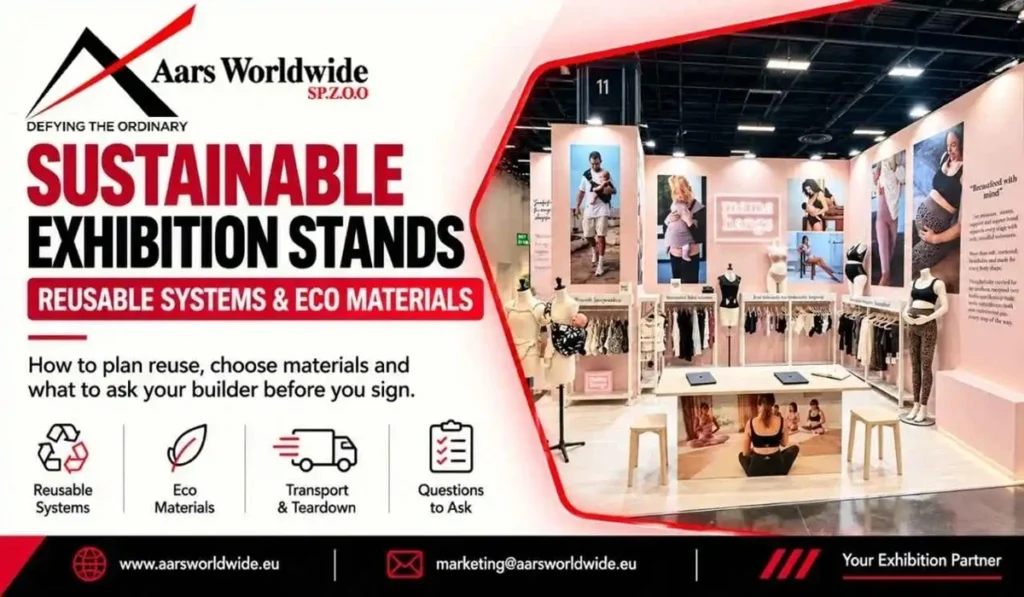
Sustainable Exhibition Stands: Reusable Systems and Eco Materials

Stay on a trade show floor until teardown and watch what happens. The stand that took weeks to design is in pieces within hours, and a lot of it heads for a skip. Most of us have seen it.

A sustainable exhibition stand is the fix, and it doesn’t have to look any different from the one next door. It just gets planned differently, mostly around two things: whether the structure can be used again, and what it’s made of. Below is how we’d think about both, plus what to ask a builder before you sign anything.

First, what “sustainable” actually means

It doesn’t mean zero impact. A stand always uses something. What you’re aiming for is fewer things made, more of them used again, and whatever’s left easier to recycle. Four questions get you most of the way. Will the structure be used more than once? What’s it built from? How far does it travel? What happens when the show ends?
It also doesn’t mean a wall of plants and a green logo. Ask for details and the greenwashing falls apart quickly.

Reusable systems do the heavy lifting

The biggest single lever is reuse, and that’s where a modular stand earns its place. Frames, graphics, counters, lighting and meeting modules can be rearranged for the next show, in a different size if you need one, with fresh graphics so the branding doesn’t look tired. You make fewer new parts and move less around.

Reuse doesn’t happen by accident though. You need graphics that work at a few different widths, counters and lighting you can standardise, and somewhere to keep it all between shows. Miss one of those and the stand gets used once and quietly retired. We cover the money side in how modular stands save time and money.

Materials worth asking about

There’s no single eco material, so don’t expect a tidy answer. A few choices do make a real difference though, and they’re worth raising when you brief a builder.
Timber with FSC or PEFC certification, if the stand uses timber at all. Aluminium, which can be recycled again and again, so ask about recycled content. Fabric graphics stretched over reusable frames, instead of rigid printed panels that get binned when the branding changes. LED lighting, which draws less power than older fittings. Furniture that’s rented or reused rather than bought for one show. And as few glued, mixed materials as you can manage, since they’re a pain to separate at the end.
We build with timber, aluminium, fabric graphics, printed panels and laminates, among other things, so ask which options fit your brief. If a builder can’t tell you what a stand is made of, that tells you plenty.

Custom doesn’t rule it out

People assume sustainable means modular. Not necessarily. A custom stand can be designed with its next life in mind: parts that come apart cleanly, finishes that last more than one show, and elements that can be reused or recycled. When the stand comes down, its components can go to storage, reuse or recycling rather than straight to disposal.

Torn between the two? Our guide on whether a modular stand is the right choice walks through it. Roughly speaking, a stand you’ll use once leans custom, and one you’ll use across several shows leans modular.

Will it cost more?

Sometimes, sometimes not. A reusable stand can cost more up front and less per show once you’ve used it a second and third time. Some eco materials are pricier, some aren’t, and a lighter structure can cut transport. The honest answer changes from show to show, so compare quotes line by line. Our breakdown of what an exhibition stand costs in Germany shows which items to look for, and you can ask your builder to price a reusable option next to a single-use one.

Don’t forget transport and teardown

Where a stand is made decides how far it travels. Our production network covers the UK, Germany, France, Poland, the Netherlands, Italy and Spain, which gives us room to build closer to the venue where it makes sense.
Teardown matters just as much, and it’s the part people ignore. Careful installation and dismantling keeps reusable components undamaged, so they can go to storage, reuse or recycling instead of the bin.

Six questions to put to your builder

Conclusion

A sustainable stand comes down to a few practical choices. Reuse what you can, build with materials you can name, and plan what happens after the show. If you’re planning your next stand, get in touch with our team and we’ll help you work out which option suits your show calendar.


Frequently Asked Questions

What is a sustainable exhibition stand?
One planned to use fewer new materials, get reused or recycled, and leave less waste behind when the show ends. It comes down to choices in design, materials and logistics, not a single label.
Often, because their parts are made to be reused. A custom stand designed for reuse and recycling can do well too. It depends on how many times the stand actually gets used.
Not necessarily. Certified timber, fabric graphics and LED lighting can look as polished as anything else.
It depends on the stand and the materials. Reuse can lower the cost over several shows. Ask for an itemised quote and compare the options side by side.
Ask for specifics: materials, reuse plans, and what happens to the stand after the show. A clear answer is a good sign. Vague claims usually aren’t.