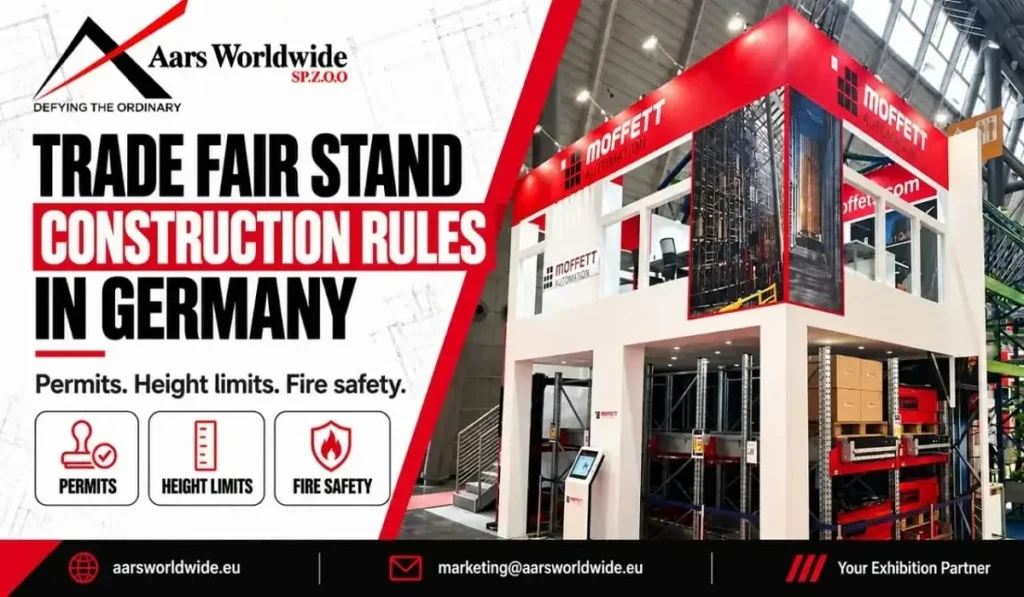
Here is a mistake that costs real money. A design gets signed off, production starts, and only then does someone open the technical guidelines and notice that the stand needs an approval nobody applied for. Or that the fabric on the walls isn’t flame-retardant. Or that the sign is taller than the hall allows.
The trade fair stand construction rules in Germany aren’t hard to follow. They’re strict, and they depend on the venue and the fair, which is why they catch so many exhibitors out. We design and build stands across Germany, so this guide covers the three things people ask about most: permits, height limits and fire safety. It’s based on technical guidelines published for recent fairs. Always check the latest version for your own show.
The short version
Where the rules come from
Germany doesn’t have one national rulebook for trade fair stands. Each venue publishes its own Technical Guidelines. Messe Frankfurt, Messe München, Messe Düsseldorf, Messe Berlin and Leipziger Messe worked together on a shared structure, so the chapters look alike: stand construction approval, construction heights, fire protection, technical services and environmental rules. The detail still differs from venue to venue.
On top of that, an individual fair can add special regulations. The guidelines are binding, and organisers can require changes or stop work that doesn’t comply. You can download Messe Frankfurt’s versions from its
technical guidelines page.
Permits: when your stand needs approval
Not every stand needs one, but many do. Messe Frankfurt, for example, lists what is subject to approval: stands with more than 100 m² of ground space, stands and exhibits over 4 m high, closed ceilings, two-storey stands and special constructions. Other venues set their own thresholds.
Approval means your drawings go to the organiser, who checks them. In Frankfurt the plans come back stamped, and construction can’t begin until they do. Plans for approval are due well ahead of set-up, around six weeks before for the fairs we checked, so look up the deadline for your specific fair. Messe Frankfurt explains the process on its stand construction authorisation page.
Your builder should prepare the technical drawings, and good
exhibition stand construction planning starts with finding out whether your stand needs approval at all. Agree in writing who submits them and who deals with questions.
Height limits
Here’s the honest answer: it depends. A few published examples show how much it varies.
Messe Frankfurt flags anything over 4 m for approval. For some fairs at Messe München, the guidelines set a maximum construction height of 6 m, and 7.5 m for two-storey stands. Some fairs add rules for walls facing a neighbour, such as a neutral, smooth finish above 2.5 m. Overhead constructions can have their own minimum clear height.
None of those numbers is a universal rule. They’re examples of what you might meet. Ask for your fair’s special regulations before the designer starts, and don’t reuse last year’s limits.
Fire safety
The rule of thumb is simple: whatever you build with, cover with or decorate with has to be flame-retardant. German guidelines refer to classifications under DIN 4102 (B1) and EN 13501-1. Messe Frankfurt’s factsheet on stand construction materials asks for flame-retardant material that doesn’t drip burning or give off toxic fumes, and says material that doesn’t comply has to be removed and replaced.
In practice, ask your builder for certificates for the materials they plan to use, and check fabrics, foams, carpets and printed graphics, not just the walls. Hot work such as grinding or welding on site usually needs written approval too. Extra fire protection checks can also add cost for stands that need approval.
Two-storey stands
A double decker stand is where most of these rules meet. At Messe Frankfurt, two-storey stands are on the approval list, and the organiser measures the upper level, stairs included. Messe München’s guidelines have a chapter just for them.
That fits what we see in the design: structural loading, stairs, headroom, fire arrangements and venue approval all need settling before fabrication starts. Ask early whether your fair and hall allow a second level, and how the upper floor counts in your fees.
Electrics, rigging and the rest
The guidelines also cover electrical installations, hanging and rigging, operational safety and environmental points such as water and noise. Some of these have their own separate guidelines. Don’t assume you can connect power or hang a sign yourself. Check who is allowed to do it and how it gets ordered.
Why last year’s plan won’t do
Even at the same venue, a different fair can mean different rules. We covered what to check at one of the busiest venues in our guide to Messe Düsseldorf stand construction rules, including recent hall changes. The lesson applies everywhere: get the current guidelines and the current hall plan, every time.
A simple timeline
What it can add to your budget
Stands that need approval can carry extra costs for structural checks and fire protection. They’re easy to miss in a quote. Our breakdown of what an exhibition stand costs in Germany shows where these extras tend to appear, and it’s worth asking your builder what sits inside the price and what doesn’t.
Questions to ask your builder
Conclusion
Get the organiser’s guidelines early, find out whether your stand needs approval, and check heights and materials before the design is signed off. That one habit prevents most of the expensive surprises. Planning a stand in Germany? Get in touch with our team and we’ll help you build around the rules from the start.
This guide is general information based on published technical guidelines. Always rely on the latest guidelines and your organiser for your fair.